Help Center Thousands of today's Charts Free trial FT4Web installed on your computer Contact us: phone, address, e-mail Of Interest to Individual Investors Of interest to Money Managers Already have FT4Web Installed? Lots of well known FastTrackers  Mutual Fund Charts
Google
Search the site for ticker symbols, fund families, stocks, or topics.
All the Web
Search FastTrack

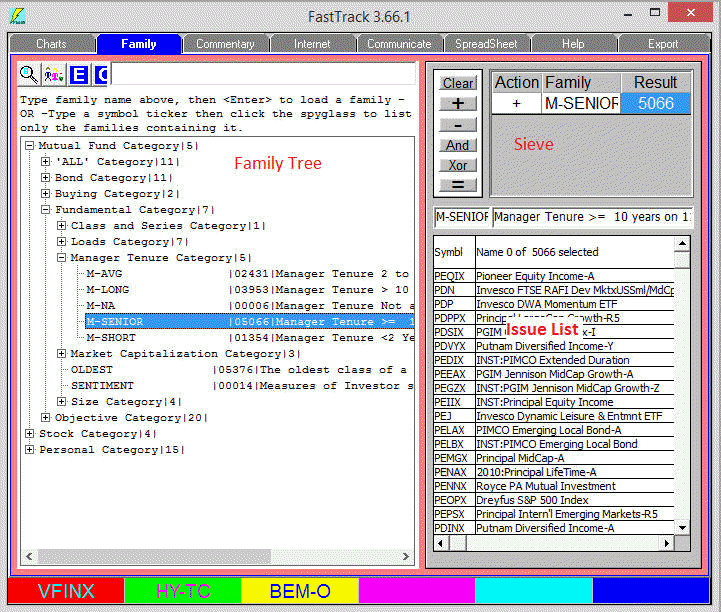
Screening Funds with the Family Editor famedit.gif (13304 bytes)

Updated 12/27/04

What's a family?

Families are saved-on-disk collections of issues according to a variety of criteria. There are FastTrack predefined families in many categories and a special category  of personal families that you create yourself using tools on FastTrack's Family Tab.

Creating a family

The following is an example of screening to create a family of issues that meets your specific criteria.

Most mutual fund advisors suggest holding a diversified portfolio of funds. Some investors take this to mean constantly holding a portion of bond funds, US Stock funds, gold funds, and international funds. But what diversification really means is to be holding funds that move in different directions.

As a training exercise, lets make a diversified family that meets the following criteria.

  1. Limit the selection to only US funds.
  2. Consider only funds with long-time, experienced managers.
  3. Include only stock funds.
  4. Pick the maverick managers whose strategies don’t match the pattern of broad market indices.

Start by clicking on the Family Tab.

  1. Clear the list in the lower right portion of the screen by right-clicking and selecting "Clear List". We will build our new screened family in this list.
  2. Add the M-Senior and M-Long families to the list by highlighting those families in the family tree on the left side of the screen.. Do one at a time. Highlight, then click the Sieve's [ + ] button. This creates a list of funds whose managers have longer than average experience at the helm of a successful mutual fund.
  3. Remove the ALL-INT family. First highlight ALL-INT in the tree, then click on the   [ - ] button  This gets rid of all international funds.
  4. Remove the ALL-INC family. Using the  [ - ] Button. This gets rid of all the income oriented funds as we want to hold more aggressively managed funds.
  5. Make a subset of funds that are in the list and that are in the COR-LOW family using the [And]  button.
  6. Save the Family. Use the name DIVERSE. Right-click the Issue List , then choose Save as Family.
  7. Click the Chart Tab to return to the charts. They have not changed despite your activity in the Family Tab.
  8. Right-click the Issue List. Choose "Load"  and expand the Personal Families Category, then double-click the DIVERSE family.
  9. This will leave you with a list of experienced-manager funds that DO NOT have a high degree of correlation to relevant broad market indices. These funds have historically been managed in a way that makes them alternatives to simply holding an S&P-500 index fund AND they still employ the managers who gave them that track record.
  10. Make VFINX the green index line. Move the mouse near the center of the chart and hit the <G> key. Enter the ticker symbol when prompted.
  11. Display the full width of the data. Move the mouse into the chart Date Zone below the blue frame. Hit <A>.
  12. Display only the T Chart. Right-click on the chart and click on "Appearance". Click once on the [Total Return] button. Then click [Draw].
  13. Click on the words "Tot Return" in the upper left of the chart. This pops open the Parameters Box that show correlation (Cor=), Standard Deviation(SD=), and Buy and Hold (BH=) return for lines.
  14. Now make the red line the AVG of the Issue List. Click the red cell in the Color Bar. Type "AVG<Enter>"
  15. Move the mouse to near the center of the chart. Step through the funds using the keyboard's <Down-Arrow>. You will notice that the Cor= value is at about 70% or less. This shows that the funds really are managed in such a way as to be different for the S&P index fund.
  16. Now make the red line the AVG of the Issue List. Click the red cell in the Color Bar. Type "AVG<Enter>". Move the mouse back to the center of the charts to redraw.

The Cor= is now HIGHER than it was for any individual fund and the red line more distinctly resembles the green line. In fact, the AVG of this low correlation family DOES HAVE a strong correlation to the S&P-500. The managers of these funds have individually pursued segments of the market rather than investing in the broad market, but each has done so in a diverse manner. The average performance is much like an index fund.

wpe5.gif (4602 bytes)So What?

You will often read magazine articles that list "unique" funds, "hot" funds, "different" funds. The article implies that the management of these funds somehow is different and that they have the potential for beating the market rather than simply following along with the crowd. THIS MAY BE TRUE IF YOU CAN PICK ONE OR TWO OF THE BEST FUNDS, but FT shows that if you buy several of these funds and simply hold them long-term, it is unlikely that you will achieve anything better than the return of an S&P index fund.

FTSMART Revisited

One such 1994 article from Money magazine gave a list of funds best positioned to endure the coming bear cycle. We reviewed this article in early 1994 in commentary. We created the FTSMART family of funds to go along with the review. Try the following:

  1. Load the FTSMART family.
  2. Make AVG the red line.
  3. Make VFINX the green line.
  4. Display only the T chart.
  5. Use the W command to set the starting date to 12/1/93 (the date of the article). The ending date should be the current date.

What you will see is that the AVG of the recommended funds has done poorly compared to the unmanaged S&P index fund. The Cor= is quite high DESPITE the premise of the article that these funds were likely to do well (and perform differently) in the "impending bear market". These funds have, on the average, 

  1. Did not beat the market in the subsequent 1994 mini-correction/flat spot.
  2. Did not beat the market subsequently through April 1999.
  3. Did worse in the correction of the fall of 1998.
customer.gif (2744 bytes)Is there HOPE?

Beating the market requires following active market strategies. These are documented throughout the commentaries and the manual. There is NO static, diversified portfolio that you can hold long-term and beat the market.